(1) No More Rare Diseases?
[Cover story] No more rare diseases? - (1)
Cover story: No more rare diseases?
The government expresses its lack of intention of augmentation in the support application policy for patients with rare diseases
The government expresses its lack of intention of augmentation in the support application policy for patients with rare diseases
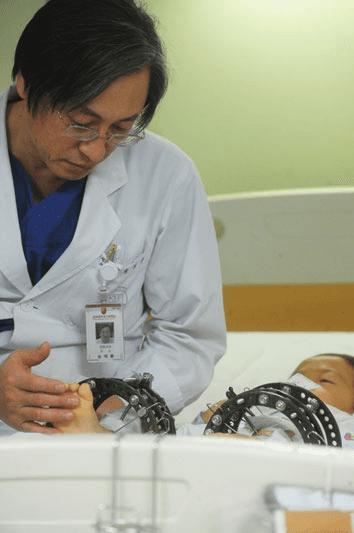
▲ Dr. Song Hae-ryong, Head of the Rare and Intractable Disease Center at Korea University Guro Hospital, is reviewing the condition of a child with achondroplasia.
▲ Dr. Song Hae-ryong, Head of the Rare and Intractable Disease Center at Korea University Guro Hospital, is reviewing the condition of a child with achondroplasia.
# When I first noticed that my first child's legs were a little more bent than other children's, I just thought, "It'll get better as they grow, it's nothing serious." Even the local doctor I visited with a worried mind only said that my child looked weak, so I paid more attention to what they ate. However, even when it was time for them to walk and run after their first birthday, they had difficulty even standing up. I wondered if there was something wrong with my child, but with anxiety, I went back to the hospital, but all they said was to watch them more or go to a big university hospital. It wasn't easy to take a child who wasn't in good health from Jeju Island to Seoul for examination. I think I had a hope that it was just a needless worry. That's why I put on leg braces and hoped that they would get healthy soon and play with other children. Then I had my second child. To make matters worse, the second child showed the same signs as the first. I couldn't just sit still anymore. I started looking for good hospitals and famous doctors. After going back and forth to large hospitals in Seoul several times, I was able to find out why my children were sick. I regretted the moments I hesitated even for a moment. I couldn't believe it, or rather, I didn't want to believe it. My children had never left the vicinity of the beach while living in Jeju Island. They were children who liked to go outside even when it was hard, until their skin was red and even peeled white. Those children have vitamin D-resistant rickets, rickets.
# When I first noticed that my first child's legs were a little more bent than other children's, I just thought, "It'll get better as they grow, it's nothing serious." Even the local doctor I visited with a worried mind only said that my child looked weak, so I paid more attention to what they ate. However, even when it was time for them to walk and run after their first birthday, they had difficulty even standing up. I wondered if there was something wrong with my child, but with anxiety, I went back to the hospital, but all they said was to watch them more or go to a big university hospital. It wasn't easy to take a child who wasn't in good health from Jeju Island to Seoul for examination. I think I had a hope that it was just a needless worry. That's why I put on leg braces and hoped that they would get healthy soon and play with other children. Then I had my second child. To make matters worse, the second child showed the same signs as the first. I couldn't just sit still anymore. I started looking for good hospitals and famous doctors. After going back and forth to large hospitals in Seoul several times, I was able to find out why my children were sick. I regretted the moments I hesitated even for a moment. I couldn't believe it, or rather, I didn't want to believe it. My children had never left the vicinity of the beach while living in Jeju Island. They were children who liked to go outside even when it was hard, until their skin was red and even peeled white. Those children have vitamin D-resistant rickets, rickets.
I traveled from Jeju Island to Seoul hundreds of times for my children's treatment, to the point where I developed a fear of flying. Whenever I saw my children struggling whenever we went to Seoul, I wanted to move near the hospital right away. But I couldn't tell my husband to quit his job and go to Seoul. The only reason I can afford the hospital bills and transportation costs is because my husband is working hard in a solid job. However, I'm worried about whether I'll be able to afford the increasing hospital bills and treatment costs as the days go by and the children grow older.
I traveled from Jeju Island to Seoul hundreds of times for my children's treatment, to the point where I developed a fear of flying. Whenever I saw my children struggling whenever we went to Seoul, I wanted to move near the hospital right away. But I couldn't tell my husband to quit his job and go to Seoul. The only reason I can afford the hospital bills and transportation costs is because my husband is working hard in a solid job. However, I'm worried about whether I'll be able to afford the increasing hospital bills and treatment costs as the days go by and the children grow older.
This is the story of Ms. A, the mother of a brother and sister with vitamin D-resistant rickets, whom I met at the Rare Disease Research Institute at Korea University Guro Hospital. Ms. A's geographical conditions are poor, but economically, she is relatively better off. Mr. B posted a post on the 'Rare and Intractable Disease Helpline' online counseling room operated by the Korea Centers for Disease Control and Prevention with the title 'Please register achalasia (esophageal achalasia) on the medical expense support list'. In his post, he said, "I went to hospitals countless times in the provinces and found out the name of the disease, achalasia, for the first time at Seoul National University Hospital," and "I paid for the hospital bills and surgery fees by taking out a loan with my father's retirement money as collateral. I hope that people like me can be registered as a rare and intractable disease so that they can reduce the burden of continuous checkups and prescriptions."
This is the story of Ms. A, the mother of a brother and sister with vitamin D-resistant rickets, whom I met at the Rare Disease Research Institute at Korea University Guro Hospital. Ms. A's geographical conditions are poor, but economically, she is relatively better off. Mr. B posted a post on the 'Rare and Intractable Disease Helpline' online counseling room operated by the Korea Centers for Disease Control and Prevention with the title 'Please register achalasia (esophageal achalasia) on the medical expense support list'. In his post, he said, "I went to hospitals countless times in the provinces and found out the name of the disease, achalasia, for the first time at Seoul National University Hospital," and "I paid for the hospital bills and surgery fees by taking out a loan with my father's retirement money as collateral. I hope that people like me can be registered as a rare and intractable disease so that they can reduce the burden of continuous checkups and prescriptions."
As President-elect Park Geun-hye announced that she would expand the coverage rate (including non-coverage) for the four major serious diseases (cancer, heart, cerebrovascular, and rare and intractable diseases) from the current 75% to 100% by 2016 (85% in 2013, 90% in 2014, 95% in 2015), interest in rare diseases has increased more than ever. However, even with President-elect Park's announcement, rare disease patients and related medical staff are showing a lukewarm response. Why?
As President-elect Park Geun-hye announced that she would expand the coverage rate (including non-coverage) for the four major serious diseases (cancer, heart, cerebrovascular, and rare and intractable diseases) from the current 75% to 100% by 2016 (85% in 2013, 90% in 2014, 95% in 2015), interest in rare diseases has increased more than ever. However, even with President-elect Park's announcement, rare disease patients and related medical staff are showing a lukewarm response. Why?
Rare disease patients are 'orphans' abandoned by society
Rare disease patients are 'orphans' abandoned by society
A rare disease refers to a disease with a prevalence of less than 20,000 people (less than 1 in 2,000 people in Europe, less than 20,000 people in the United States). Currently, there are about 7,000 known rare diseases, of which only about 10% have treatments developed. Because there are so few patients, there is relatively less public interest. For example, in English, rare disease drugs are even referred to as 'Orphan Drugs'. The word 'Orphan', which means 'orphan' or 'isolated (or abandoned)', is a word that directly reflects the reality of rare disease patients who have few experts who can research and diagnose the disease, and it is difficult to expect the development of treatments (due to low marketability, etc.).
A rare disease refers to a disease with a prevalence of less than 20,000 people (less than 1 in 2,000 people in Europe, less than 20,000 people in the United States). Currently, there are about 7,000 known rare diseases, of which only about 10% have treatments developed. Because there are so few patients, there is relatively less public interest. For example, in English, rare disease drugs are even referred to as 'Orphan Drugs'. The word 'Orphan', which means 'orphan' or 'isolated (or abandoned)', is a word that directly reflects the reality of rare disease patients who have few experts who can research and diagnose the disease, and it is difficult to expect the development of treatments (due to low marketability, etc.).
It is impossible for individual rare disease patients to diagnose, treat, and care for themselves. Therefore, they have no choice but to rely on the support of the state and social organizations. The government also started providing medical expense support for 4 rare diseases, including ▲chronic renal failure, ▲hemophilia, ▲muscular dystrophy, and ▲Gaucher's disease in 2001, and gradually increased the target to 6 types in 2002 and 8 types in 2003, and last year, it was expanded to 134 types (the number of medical care benefit recognition targets was expanded from 107 to 144 this year). The 134 types of rare disease patients who are subject to government support are receiving support through the 'Rare and Intractable Disease Calculation Special Exemption System', which reduces the patient's co-payment to 10%, and the 'Patient Co-payment Ceiling System', which sets a co-payment ceiling according to income level and refunds the excess medical expenses from health insurance. In addition, for some rare diseases, non-benefit items such as nursing care expenses, respiratory aids, cough inducers, and special diet purchase expenses are also supported.
It is impossible for individual rare disease patients to diagnose, treat, and care for themselves. Therefore, they have no choice but to rely on the support of the state and social organizations. The government also started providing medical expense support for 4 rare diseases, including ▲chronic renal failure, ▲hemophilia, ▲muscular dystrophy, and ▲Gaucher's disease in 2001, and gradually increased the target to 6 types in 2002 and 8 types in 2003, and last year, it was expanded to 134 types (the number of medical care benefit recognition targets was expanded from 107 to 144 this year). The 134 types of rare disease patients who are subject to government support are receiving support through the 'Rare and Intractable Disease Calculation Special Exemption System', which reduces the patient's co-payment to 10%, and the 'Patient Co-payment Ceiling System', which sets a co-payment ceiling according to income level and refunds the excess medical expenses from health insurance. In addition, for some rare diseases, non-benefit items such as nursing care expenses, respiratory aids, cough inducers, and special diet purchase expenses are also supported.
The number of support targets and scope has increased over the past 12 years, but the budget has been inconsistent. Since 2009, the budget has actually decreased. The government budget for rare diseases steadily increased from 22.641 billion won in 2001 to 39.124 billion won in 2007, but temporarily decreased to 37.512 billion won in 2008, and then increased again to 43.216 billion won in 2009. However, it continued to decrease to 39.013 billion won in 2010, 32.481 billion won in 2011, and 31.47 billion won in 2012.
The number of support targets and scope has increased over the past 12 years, but the budget has been inconsistent. Since 2009, the budget has actually decreased. The government budget for rare diseases steadily increased from 22.641 billion won in 2001 to 39.124 billion won in 2007, but temporarily decreased to 37.512 billion won in 2008, and then increased again to 43.216 billion won in 2009. However, it continued to decrease to 39.013 billion won in 2010, 32.481 billion won in 2011, and 31.47 billion won in 2012.
Support is determined depending on the type of rare disease
Support is determined depending on the type of rare disease
The most important thing for rare disease patients is, of course, financial support. In particular, a significant number of rare diseases are caused by genetic factors, and it is difficult to afford expensive treatments that are not easy to develop, so it is difficult for anyone who does not have considerable economic power to escape economic problems. Ms. A's concerns in the previous interview are in the same context. However, not only is the related budget continuing to decrease, but it is also difficult to expect an expansion of support targets.
The most important thing for rare disease patients is, of course, financial support. In particular, a significant number of rare diseases are caused by genetic factors, and it is difficult to afford expensive treatments that are not easy to develop, so it is difficult for anyone who does not have considerable economic power to escape economic problems. Ms. A's concerns in the previous interview are in the same context. However, not only is the related budget continuing to decrease, but it is also difficult to expect an expansion of support targets.
Park So-yeon, a health researcher at the Cardiovascular and Rare and Intractable Disease Division of the Korea Centers for Disease Control and Prevention, said, "There are criticisms that applying the calculation special exemption system and the patient co-payment ceiling system to rare disease patients and providing duplicate support is contrary to fairness compared to patients with other diseases," and "The work of increasing the number of supported diseases has been suspended. Initially, we tried to supplement the existing support (calculation special exemption + patient co-payment ceiling) last year, but we could not find a better supplement, so we decided to maintain the current support system until 2015."
Park So-yeon, a health researcher at the Cardiovascular and Rare and Intractable Disease Division of the Korea Centers for Disease Control and Prevention, said, "There are criticisms that applying the calculation special exemption system and the patient co-payment ceiling system to rare disease patients and providing duplicate support is contrary to fairness compared to patients with other diseases," and "The work of increasing the number of supported diseases has been suspended. Initially, we tried to supplement the existing support (calculation special exemption + patient co-payment ceiling) last year, but we could not find a better supplement, so we decided to maintain the current support system until 2015."
Even if President-elect Park Geun-hye's promise is implemented, it is only applied to the current 134 types, so the appeal to increase the number of support targets like Mr. B, who is an achalasia patient, is likely to remain only an echo.
Even if President-elect Park Geun-hye's promise is implemented, it is only applied to the current 134 types, so the appeal to increase the number of support targets like Mr. B, who is an achalasia patient, is likely to remain only an echo.
From the government's point of view, it will not be easy to increase support for those who are small in number, only a few or dozens of people. Therefore, it is understandable that they have no choice but to apply the fairness standard compared to thousands or tens of thousands of patients. Then, is the current rare disease support system being operated fairly?
From the government's point of view, it will not be easy to increase support for those who are small in number, only a few or dozens of people. Therefore, it is understandable that they have no choice but to apply the fairness standard compared to thousands or tens of thousands of patients. Then, is the current rare disease support system being operated fairly?
As mentioned above, 'rare disease' refers to a disease with a prevalence of less than 20,000 people in Korea, that is, a disease that a small number of patients have. However, the current 134 types of rare diseases that are subject to support also include 'chronic renal failure (limited to patients undergoing dialysis who have received a grade 2 disability for kidney disease)' and 'Parkinson's disease'. As of 2009, the number of dialysis patients among chronic renal failure patients who are eligible for rare disease support is known to be 56,395 (End-Stage Renal Disease Patient Registration Project of the Korean Society of Nephrology). The situation is not much different for Parkinson's disease patients. In other words, if the principle is followed, chronic renal failure patients and Parkinson's disease patients cannot be subject to rare disease support.
As mentioned above, 'rare disease' refers to a disease with a prevalence of less than 20,000 people in Korea, that is, a disease that a small number of patients have. However, the current 134 types of rare diseases that are subject to support also include 'chronic renal failure (limited to patients undergoing dialysis who have received a grade 2 disability for kidney disease)' and 'Parkinson's disease'. As of 2009, the number of dialysis patients among chronic renal failure patients who are eligible for rare disease support is known to be 56,395 (End-Stage Renal Disease Patient Registration Project of the Korean Society of Nephrology). The situation is not much different for Parkinson's disease patients. In other words, if the principle is followed, chronic renal failure patients and Parkinson's disease patients cannot be subject to rare disease support.
Kim Hyun-joo, chairman of the Korea Rare Disease Foundation, said, "I know that there are more than 40,000 people registered as (rare disease patients) due to renal failure," and "Renal failure does not meet the definition of a rare disease. Rather, it is a disease that requires systematic management as a chronic disease. Due to this wrong policy, rare disease patients who really need support are not being included in the support target."
Kim Hyun-joo, chairman of the Korea Rare Disease Foundation, said, "I know that there are more than 40,000 people registered as (rare disease patients) due to renal failure," and "Renal failure does not meet the definition of a rare disease. Rather, it is a disease that requires systematic management as a chronic disease. Due to this wrong policy, rare disease patients who really need support are not being included in the support target."
The government is also aware of these systemic loopholes. Park Hyun-young, head of the Cardiovascular and Rare and Intractable Disease Division of the Korea Centers for Disease Control and Prevention, said, "The reason why we are currently supporting renal failure and Parkinson's disease by grouping them with rare and intractable diseases is not because we do not know the prevalence rate, but because there is no support for them."
The government is also aware of these systemic loopholes. Park Hyun-young, head of the Cardiovascular and Rare and Intractable Disease Division of the Korea Centers for Disease Control and Prevention, said, "The reason why we are currently supporting renal failure and Parkinson's disease by grouping them with rare and intractable diseases is not because we do not know the prevalence rate, but because there is no support for them."
[Source: The Doctors http://www.docdocdoc.co.kr/news/newsview.php?newscd=2013013000020 ]
[Source: The Doctors http://www.docdocdoc.co.kr/news/newsview.php?newscd=2013013000020 ]