[Kookmin Ilbo] Korea University Guro Hospital Rare & Intractable Disease Center
[Korea University Medical Center Cancer Center and Intensive Care Center]
Korea University Guro Hospital Rare and Intractable Disease Center
Leading the way in solving the silent 'triple burden' of rare and intractable diseases
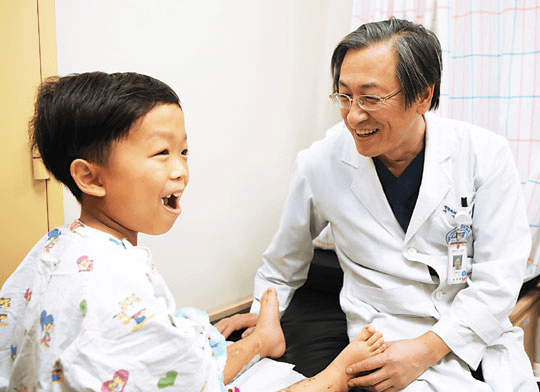
Professor Song Hae-ryong, pediatric orthopedic surgeon and director of the Rare and Intractable Disease Center at Korea University Guro Hospital, is checking the leg correction status of a child with short stature undergoing rehabilitation after femoral lengthening surgery and having a conversation. Provided by Korea University Guro Hospital
In the summer of 2014, the Ice Bucket Challenge campaign, which started in the United States and spread around the world, greatly helped to empathize with the suffering of patients with the rare disease Lou Gehrig's disease, or 'Amyotrophic Lateral Sclerosis' (ALS), and practice sharing.
However, in fact, Lou Gehrig's disease is not the only rare and intractable disease. In addition to this disease, there are about 2,000 types of diseases classified as rare and intractable diseases, such as GABA receptor mutation syndrome, fetal alcohol syndrome, ankylosing spondylitis, and short stature. On the other hand, the total number of patients is only 500,000. This is because the number of patients nationwide for each disease is mostly less than several hundred, and at most 2,000 to 3,000.
Korea University Guro Hospital established the Rare and Intractable Disease Center (Director Song Hae-ryong, Professor of Pediatric Orthopedics) in 2008 and has been a leading medical institution in helping patients with about 60 musculoskeletal rare and intractable diseases.
Professor Song and his team have gained a reputation for providing the highest level of medical services in Korea to patients based on their extensive clinical experience in the treatment of musculoskeletal rare and intractable diseases such as Lou Gehrig's disease, multiple epiphyseal dysplasia, ankylosing spondylitis, Sjogren's syndrome, and short stature.
Professor Song and his team are especially praised by patients for involving not only the 담당 professor but also dedicated nurses and social workers in all 진료 and education processes from consultation to examination to surgery in order to solve the problems of early rehabilitation and social welfare for patients with rare and intractable diseases.
Professor Song's team is characterized by operating the center in a way that professors from various departments needed for one patient gather in one place to provide collaborative care. In other words, pediatric orthopedic surgeon Song Hae-ryong specializes in short stature and limb deformity correction, and Professor Seo Seung-woo specializes in spinal diseases such as myopathy, scoliosis, and ankylosing spondylitis, but they frequently collaborate with professors from other departments as needed.
This is why Professor Song and his team are now able to provide optimal personalized 진료 services to patients with various musculoskeletal rare and intractable diseases through multidisciplinary collaboration with professors from various departments, including pediatric and adolescent medicine, rheumatology, hematology-oncology, gastroenterology, thoracic surgery, neurology, anesthesiology and pain medicine, plastic surgery, rehabilitation medicine, and family medicine.
Meanwhile, physical pain is not the only problem for patients with rare and intractable diseases. Psychological, social, emotional, economic, and personal problems often make it difficult to treat, recover from, and prevent disease.
Professor Song and his team are helping patients focus on treatment by resolving or supporting the economic difficulties of musculoskeletal rare and intractable disease patients and their families through close cooperation with the medical social work team within the hospital.
One of them is a project that connects various social welfare organizations and companies, such as the Life Insurance Social Contribution Foundation, Interalia Public Interest Foundation, and Namchon Foundation, and individual donors with economically disadvantaged rare and intractable disease patients and their families on a one-to-one basis to support medical expenses.
Most domestic rare and intractable disease patients are experiencing many difficulties due to a lack of information about the diseases they are suffering from. Accordingly, Professor Song and his team are also working hard to operate various education programs and provide useful medical information that helps with treatment and management.
Professor Song and his team are also conducting free spinal and limb deformity screening for facilities for the disabled nationwide. This is to prevent complications by early detection and appropriate treatment of scoliosis in people with disabilities. Of course, in the case of people with disabilities who need surgery, free surgery is also arranged in consultation with the medical social work team.
[Source]
[Kookmin Ilbo] Article published on "[Korea University Medical Center Cancer Center and Intensive Care Center] (8) Korea University Guro Hospital Rare and Intractable Disease Center."
2014.12.23
[KUKMINILBO] Korea Uni. Guro Hospital Raredisease Center. 2014.12.23
Link : http://news.kmib.co.kr/article/view.asp?arcid=0922888821&code=14130000&cp=nv